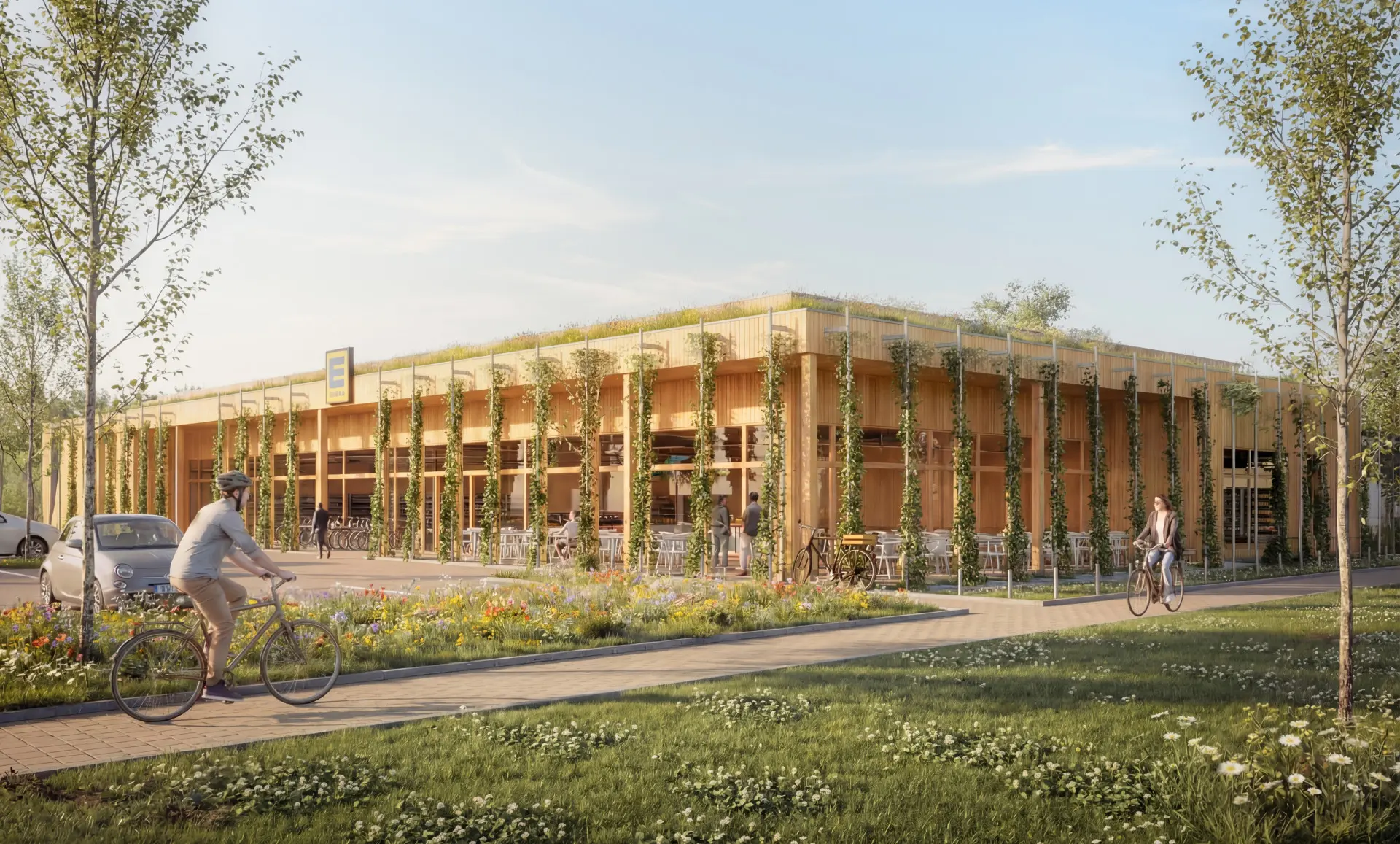

When a Supermarket Becomes a Biotope: How RATISBONA and Hula Earth Bring Nature Back to Retail
People in Germany visit supermarkets around 15 billion times a year. Historically, this has meant massive resource consumption, urban heat islands, and completely sealed soil.
A revolutionary project in Haimhausen, Bavaria, proves that things can be done differently. This is the LOOP Markt Haimhausen, developed by RATISBONA Handelsimmobilien and operated by EDEKA Südbayern and Backstube Wünsche. It is Europe's first supermarket built strictly according to Cradle-to-Cradle principles, meaning all building components are fully circular, allowing them to be separated and reused at the end of their lifecycle.
The real highlight, however, waits right outside the doors and on the roof. This project shatters the old rule that real estate must always take away space from nature.
0.05%: Rescuing a Vanished Habitat
Standard green spaces around commercial real estate are often ecologically dead. The LOOP Markt flips this approach entirely: the explicit goal is to host more animal and plant species on site after construction than before.
This is an ambitious promise in the Dachau district, where intensive land use has left only 0.05% of the region's original, historic heath and dry grassland habitats. To bring this ecosystem back, the nutrient-rich topsoil was removed and replaced with a nutrient-poor substrate. Combined with local seeds, sand islands, a lizard castle, and deadwood hedges, a thriving biotope is being born. Additionally, a 1,300 m² extensive green roof acts as a species reservoir, actively dispersing seeds into the surrounding landscape.
Measurable, Not Asserted: The Shift to Qualitative Economics
RATISBONA operates on the principle of qualitative economics: buildings must generate measurable ecological value. While a digital building passport documents the circularity of the construction materials, the outdoor nature strategy requires equally unassailable proof.
This is where Hula Earth comes in.
Saving biodiversity only works if you can see whether your measures actually hit the mark. Landscape architects traditionally map local flora and fauna in the field, providing an invaluable baseline. Hula Earth scales this monitoring with technology: intelligent, AI-powered BioT sensors track the area 24/7. These solar-powered devices analyse real-time acoustic and microclimatic signals right on site.
- Which species are actually utilising the newly created habitats?
- How does biological activity evolve across different seasons?
- Are the target species of the dry grassland successfully settling in?
The AI automatically translates every signal into actionable insights. Providing a continuous, scientifically robust data stream, the system acts like a digital biologist that never leaves the site.
The Supermarket as an Ecological Stepping Stone
The LOOP Markt provides food, nesting sites, and shelter within an intensively farmed agricultural landscape. By partnering with Hula Earth, this success becomes both measurable and replicable.
The collected data offers the blueprint needed to scale this approach across numerous future commercial locations. If other supermarkets follow this lead, we can gradually build a functional network of habitats right within our commercial zones. Moving from a well-intentioned promise to a data-backed, verifiable KPI is exactly what the future of retail looks like.