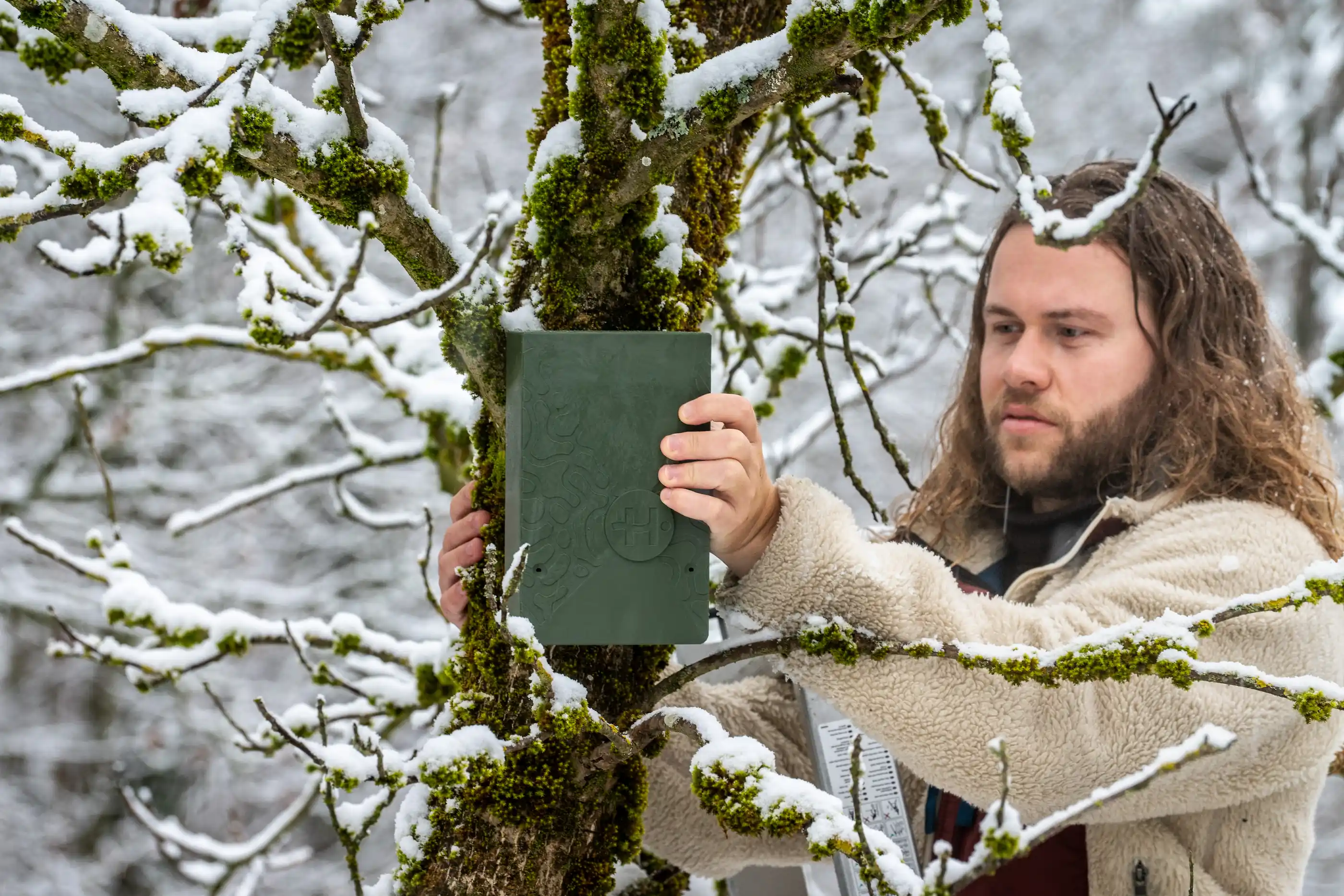
Photo: Andreas Heddergott | CTO David Schmider installs a sensor near Perlacher Forst.

Update: The Partnership with the State Capital Munich reaches new Heights!
Munich, Germany — What began in September with three devices in Magdalenenpark has developed into a genuine small monitoring network. We are pleased to report today that all 13 sensors agreed upon as part of the "Munich Urban Jungle: Digitising Biodiversity!" Innovation Challenge have now been deployed and are diligently collecting data. This is a milestone — and the perfect moment for a detailed update.
Where we started
In September, we installed the first three devices in Magdalenenpark – a green oasis in the cityscape. The ecologically valuable Magdalenenpark in Pasing is a former monastery garden and was opened in November 2024 by the Bund Naturschutz nature conservation association.
We reported on this initial deployment in our YouTube video, but also in the Süddeutsche Zeitung and Rathaus Umschau newspapers, which impressively reflected the enormous public interest in this topic. The first few weeks in the field already provided exciting insights into the biodiversity of this urban hotspot. Building on this success, 10 additional sensors have been put into operation at strategically selected locations in Munich over the past few months.
Expansion into urban areas
Some of the new devices were installed in southeast Munich – in the middle of everyday city life, right next to busy roads and tram lines. This is no coincidence: the aim here is to specifically investigate how birds behave in heavily sealed, noisy environments – and what this means in comparison to green retreats such as Magdalenenpark.
The last devices at Westfriedhof cemetery
After a short Christmas break, the project continued apace. Two weeks ago, the last sensors were installed at Westfriedhof cemetery – a place with its own unique ecological profile thanks to its old trees, neighbouring allotment gardens, and peaceful surroundings.
The Hula Earth team was in good company on the installation day: two employees from the City of Munich's Department of Climate and Environmental Protection personally accompanied the installation. A city public relations officer was also there to capture the moment on camera. It is precisely this kind of collaborative, goal-oriented cooperation that makes this project so special for us.
What the data shows so far
Now that the entire network is active, the data is beginning to paint an increasingly clear picture. More than 50 bird species can already be tracked on our platform – even though the period covered, from September to February, is a weaker phase for species diversity in ornithological terms.
Initial patterns are also becoming apparent: as expected, there are clear differences between the densely populated measuring stations in the city centre and biodiversity hotspots such as Magdalenenpark or Westfriedhof. At the same time, there are also surprises that show how resilient nature is, even in the city.
Why the project is important
The goal of the Innovation Challenge goes beyond simply collecting data: it aims to investigate the extent to which modern technology can structurally support the work of the Climate and Environmental Protection Unit. Traditional mapping is valuable, but it is labour-intensive, difficult to scale, and time-limited. AI-supported acoustic sensor technology, which runs around the clock, throughout the year, and without human intervention, can take the data basis for nature conservation decisions to a whole new level. Not as a replacement for human expertise, but as a powerful tool that complements and strengthens it.
What comes next
With the completion of the deployment phase, what is perhaps the most exciting phase of the project in terms of content is now beginning:
In the next step, the results from the citizen science database evaluation will be transferred to the state capital's database. This will create a combined treasure trove of data – automated primary data from the Hula network, enriched by years of observation data collected by the community.
The crowning glory will be the joint review of the results in the summer of 2026, when our automated monitoring data will be compared directly with classic mapping carried out in parallel. We are very excited to see what this comparison will reveal.
Until then, we would like to express our sincere thanks to the entire team at the Department of Climate and Environmental Protection for their excellent, uncomplicated, and always motivated cooperation. We would also like to thank the Munich Innovation Challenge team for their ongoing support!
This project shows what is possible when technology and administration really pull together. We are very much looking forward to the coming months!