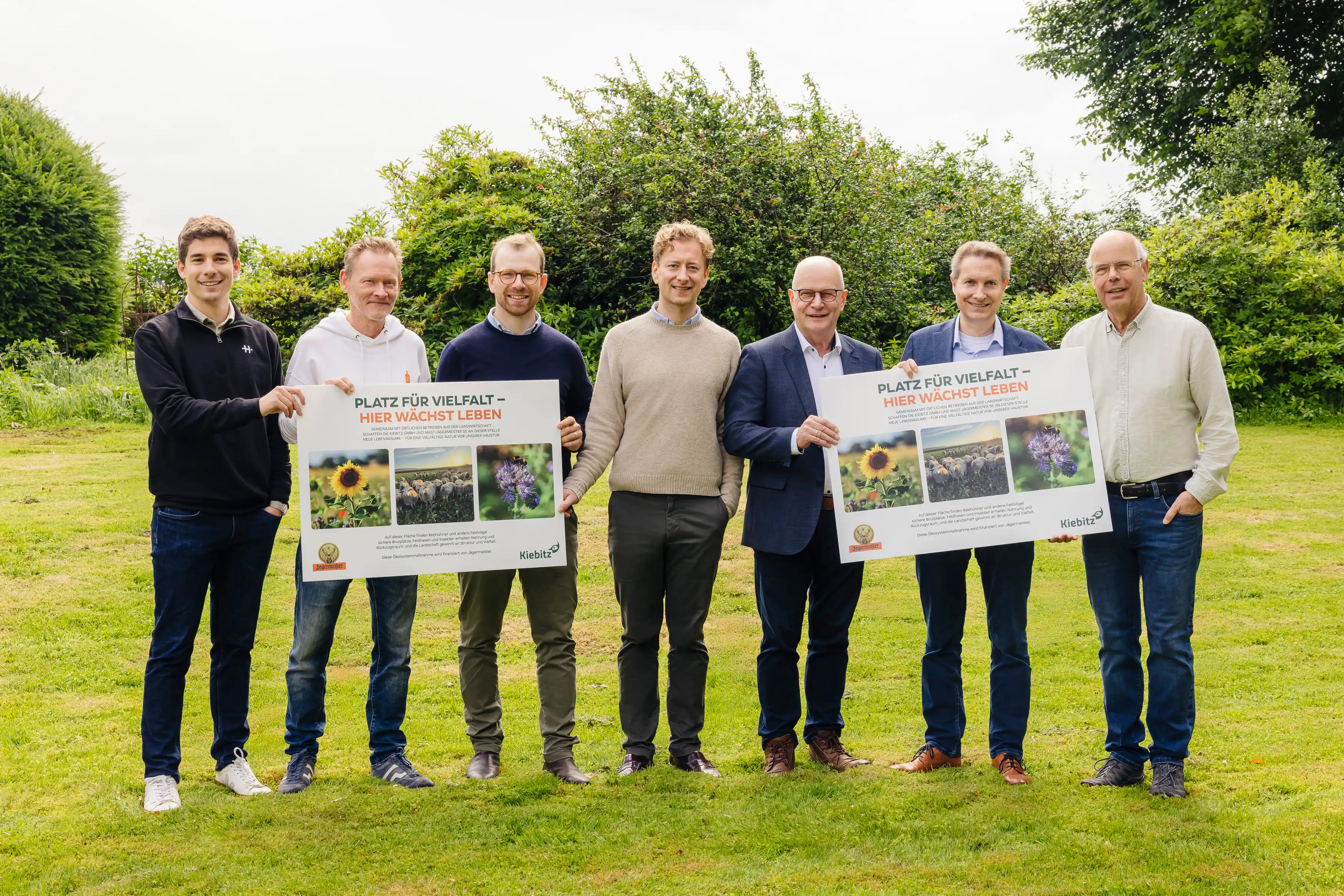
Pictured: Florian Geiser (Hula Earth), Andreas Einig (Mast Jägermeister SE), Ludwig Riedesel and Georg König (Kiebitz.Land), and Stefan Böske, Mayor of the City of Enger

Biodiversity as Part of Resilient Supply Chains: How Jägermeister Makes Impact Measurable with Real Field Data
For many players in the food and beverage sector, biodiversity has long been primarily a topic for sustainability reports. But a growing number of companies are taking a different approach: driven by tangible climate shifts, ecosystem health is increasingly becoming a focus of risk management. To secure planning reliability and build resilient, local supply chains, Jägermeister is investing directly in nature on the ground. At Jägermeister, this happens in the field. The herbal liqueur is made from natural raw materials, making the company dependent on intact ecosystems. Ecosystem health is therefore not a question of values, but a variable in the supply chain. One response to the threat of nature loss is land set-aside: productive land is taken out of use to protect ecosystems. At 15 percent, this protects ecosystems, but significantly reduces available arable land and therefore the long-term viability of the supply chain. The better answer is integration. Productive land use and biodiversity do not have to be mutually exclusive. But this requires data.
The Challenge: Farmers Are Open to Regenerative Practices, but Guidance Is Often Missing
The willingness is there. Many farmers are open to regenerative land management. What is missing is reliable, site-specific guidance: which measures actually work, and where? Flower strips, extensive cereal cultivation, and habitat areas are being used more and more frequently. Without continuous, standardised monitoring, however, their impact is difficult to compare, track over time, or demonstrate credibly to investors and stakeholders. This is exactly where Hula Earth comes in.
From Field Data to Concrete Action
Hula Earth's BioT sensors were installed on the project sites to capture bioacoustic and microclimate data in real time. Every animal signal is automatically translated and analysed directly on the device by AI, with no manual surveys and no data gaps. The Hula platform integrates data at both farm and landscape level. A measure that works on one sub-area can look very different in a landscape context. Only by understanding both levels can monitoring be translated into strategy.
What the Data Shows
On one of the monitoring sites, 57 bird species and more than 12,700 individual records were captured in a single spring season. Activity levels were around six times higher than on comparable reference sites nearby. Birds are reliable indicator species for ecosystem health. Their presence signals intact habitats, active insect populations, and land management measures that are working. When bird species diversity increases, it reflects the health of the entire ecosystem, from soil organisms to pollinators to plant communities. For Jägermeister, this was not just encouraging. It was the evidence that made the step from pilot project to long-term partnership possible.
"It quickly became clear how complex the topic is, and how important collaboration is to turn ideas into viable solutions."
Mast-Jägermeister SE
Why Continuous Monitoring Makes the Difference
One strong data season is a promising start. What builds supply chain resilience is the trend over time. Hula Earth's sensors run autonomously, solar-powered and maintenance-free, throughout the entire year. Based on the data collected, the platform regularly generates concrete recommendations: which measures can be scaled up? Where is action needed? How do different management approaches compare over time? This is the equivalent of continuous advice from a biologist who never leaves the site. Jägermeister can use this to measure how biodiversity changes in response to specific measures, compare sites with one another, and build a data foundation that informs both land management and sustainability reporting.
Finding the Optimum Between Set-Aside and Productive Land
The goal is to find the optimum between land set-aside and productive cultivation. At both farm and landscape level, data-driven management shows where nature-compatible practices have the greatest effect and create the least conflict between objectives. This makes it possible to reduce the share of set-aside land without compromising biodiversity.
Biodiversity as a KPI, Not a Value
What makes this project significant beyond the field results is the mindset behind it. Jägermeister views biodiversity as a key indicator of the long-term stability of its sourcing regions and the future viability of its agricultural partnerships. This shift, from biodiversity as a statement of intent to biodiversity as a measurable KPI, is what the food and agricultural sector needs. And this is exactly what Hula Earth makes possible.